Looking for more holiday deals? Visit our Guide to Cyber Week to see all the best sales to shop before — and during — Black Friday. For the first time in nearly two years, the travel industry is showing huge signs of optimism for a return to …
Supply chain issues or no, it’s beginning to look a lot like the holiday shopping season in places like New York City. U.S. retail sales surged in October. Noam Galai/Getty Images The supply chain may not be the Grinch that steals Christmas, after all. Despite concerns …
In 1941, Arkansas operated eight state parks. Seven were open only to white visitors. The eighth was set aside for the second-class citizens politely called Negroes.
Peaches were a major cash crop in Arkansas back then. At now vanished Highland Peach Orchard, south of Murfreesboro, nearly a million Elberta peach trees reached as far as the eye could see.
Fox hunting still took place in rural Arkansas eight decades ago, but without the English tradition of riding to hounds. Local hunters preferred to relax outdoors with a smoke and a drink while listening for the distinctive bark of each dog pursuing the fox.
Toby shows toured the state’s rural areas before World War II. The barker, known as “Toby,” would hawk candy boxes touted to contain tickets for winning a plaster elephant or some other gewgaw. Then he and a couple of supporting players would pass the hat as they entertained the crowd with homespun comedy.
And in Little Rock as the Great Depression ended, a dozen homeless families lived in shacks of scrap lumber and tar paper on a riverfront patch known as Squatters’ Island. Viewed as a tourist attraction, they grew tomatoes, okra, peppers and pumpkins in the alluvial soil.
Those time-warp nuggets and countless more are scattered among the lodes of information, much of it fascinating and some even amazing, in the 448 pages of “The WPA Guide to Arkansas.”
The book, created for the New Deal’s Works Progress Administration by a platoon of federally paid writers and editors, was printed in 1941. It was among the last of 48 state guides published, starting in 1937, by the agency’s much debated Federal Writers’ Project. The series also included the Alaska Territory, Puerto Rico and Washington, D.C.
Reprinted in 1987 with a fresh introduction as “The WPA Guide to 1930s Arkansas,” the original volume wafts today’s readers back to what was then the mainly rural “Wonder State” but soon to get a new nickname: “Land of Opportunity.”
Today, Bentonville has 54,164 residents and the 2020 Census estimated 546,725 residents in the Fayetteville-Springdale-Rogers metro area. Bentonville’s population in the 1940 U.S. Census was 2,359. Springdale’s was 3,319. Rogers’ was 3,550. Fayetteville’s was 8,212. The combined count of 17,430 in 1940 was handily surpassed by the 21,290 for Pine Bluff — then the state’s fourth largest city, now down to No. 10.
The guide’s 1987 edition can be bought online for $25 to $40 or read for free at some libraries (there are other reprints as well, including one by Trinity University Press in 2013). The 1941 original sells in some venues for hundreds of dollars. The contents portray Arkansas at a fracture point between the Great Depression and U.S. entry into World War II. Countless sights, often routine back then but vanished or altered now, flash by on the guide’s eight city tours and 17 driving routes (sometimes on unpaved state highways).
POTPOURRI OF TOPICS
Preceding the extensive touring sections are 19 essays on a potpourri of topics that shed light on public and private life eight decades back. Among the subjects are Natural Settings, Archaeology and Indians, History, Transportation, Agriculture, Recreation, Religion, Folklore and Folkways, Government, and Music.
In charge of the guide when the project began in 1938 were notable Arkansas literary figures Bernie Babcock and Charles J. Finger. They were soon replaced by Dallas McKown, who completed the process under the sponsorship of then-Secretary of State C.G. “Crip” Hall. The list of consultants mentioned 147 contributors.
“To obtain information for the guide, workers of the Arkansas Writers’ Project have haunted libraries, handled countless faded documents in archives, and have read hundreds of books, magazines and newspapers,” McKown wrote. “They have driven thousands of miles over highways that crisscross the Delta, slice through deep pine forests, follow river valleys, and ride the ridges of the Ozarks and Ouachitas.”
The Federal Writers’ Project drew persistent criticism nationally from conservative quarters, notably the House Un-American Activities Committee. Charges by the committee focused on alleged Communist connections or sentiments that were never substantiated. The accusations included the supposed promoting of racial integration, at a time when Jim Crow laws ruled the South and racial discrimination was widespread elsewhere.
“The WPA Guide to Arkansas” contains no evident sympathy for any easing of legal segregation — much less ending Jim Crow laws. Separate public facilities are mentioned as a matter of natural course, as with “Watkins State Park (for Negroes), 8.9 m. NW of Pine Bluff on U.S. 270.” The park is no longer on the map.
STEREOTYPES in 1941
Black communities are covered on the eight city tours and elsewhere in the guide. But urban Black people are often depicted in stereotypical terms as happy-go-lucky sorts looking mainly for a good time. Comments about rural Black people can be even more offensive, focusing on ignorance and superstitions. Reading them in 2021 would offend many readers of any skin color.
The guide also echoes some stereotypes about backwoods white Arkansans, as in these descriptions from a route through Newton County south of Jasper:
“The women wear sunbonnets, and many of them use snuff, taking a small quantity on the end of a ‘rough elm toothbrush,’ and chewing it like plug tobacco. Hill people consider dipping snuff, or putting it on the lower lip, an unclean habit, fit only for white trash and lowlanders.
“The men are weather-beaten and have tiny wrinkles about their eyes. Their loose-kneed, shambling gait is ungraceful, but deceptively fast, whether they strike out for town six or eight miles away, or are just making a circle to kill a few squirrels.”
MULE POWER
Arkansas agriculture was becoming more mechanized as World War II loomed, progress reflected in this tribute to the mule:
“Though their number has declined since tractors took over much of the level land, mules are still preferred to horses in cotton fields. The mule is tough, stubborn and wiry. He drinks water so muddy that a self-respecting horse would snort at it. He humps his back to a wintry wind and nibbles forage a mustang would scorn.”
On Saturdays, farmers and their families would head to the nearest town. Main Streets were the centers of shopping, well before the advent of shopping malls on arteries leading to interstates and other highways. This is what it was like in Blytheville:
“Main Street is a wide sunny avenue lined with brick stores and offices. Shoppers are most numerous on Saturdays. On this day, the stores put on extra clerks, barbecue and hamburger stands prepare for a rush, and the motion-picture theaters bill Western thrillers.
“Farm people pack the sidewalks to sell produce, buy groceries and drygoods, and meet their friends. Sacks of feed and coops of squawking chickens are piled high outside the stores at the eastern end of Main Street. Perhaps a huge catfish, fresh-hooked from a Mississippi slough, dangles before a lunchroom.”
Hot Springs was also lively as it welcomed tourists, but with leisure activities mostly different from today:
“Outdoor photograph studios, where visitors have their pictures taken astride a slumbering burro or behind a prop saloon bar, spring up in vacant lots next to sumptuous hotels. Small shops serve fresh seafood, fruit juices or goat’s milk. Stands display crystals, curios, souvenirs and trinkets. In the narrow canyons, patrons of shooting galleries blaze away into the mountainside.”
The guide’s 1987 reprint added a new introduction by Elliott West, a University of Arkansas, Fayetteville historian. He asserted that “if there is a common theme uniting the past and the present and the state’s various parts, it is that of poverty.”
That is less true in 2021 in the state’s metropolitan areas, but it remains a lamentable fact of life in many small towns and rural areas. Per-capita income in Arkansas today ranks 45th among the 50 states.
RHAPSODIES
But the opening pages of the original edition cite Arkansas’ non-monetary treasures. These other avenues of pleasure are described in rhapsodic terms, which curmudgeonly readers might view as saccharine:
“Part of the wealth of Arkansas today is not in its minerals and forests, but in the sights and sounds encountered by a visitor.
“It may be the small thunder of a covey of quail that he will remember longest, or a flight of mallards wheeling down into a swamp because of a hunter’s expertly rendered call, or the bright glow of straw stacks burning in the rice fields after threshing time. The zigzag rail fences overgrown with honeysuckle, the clear smokeless air in the cities, the tumbling of the mountains eastward from Winslow, the smell of wood smoke from a great stone chimney at the end of a cabin, the pungency of pine sawdust and the whine of the saw biting into a log, the clumps of mistletoe in leafless trees.
“You won’t forget these things soon, even though they are not the important aspects of Arkansas, where the politeness of the South and the friendliness of the West are both responsible for the personal tone in ‘Y’awl hurry back.'”
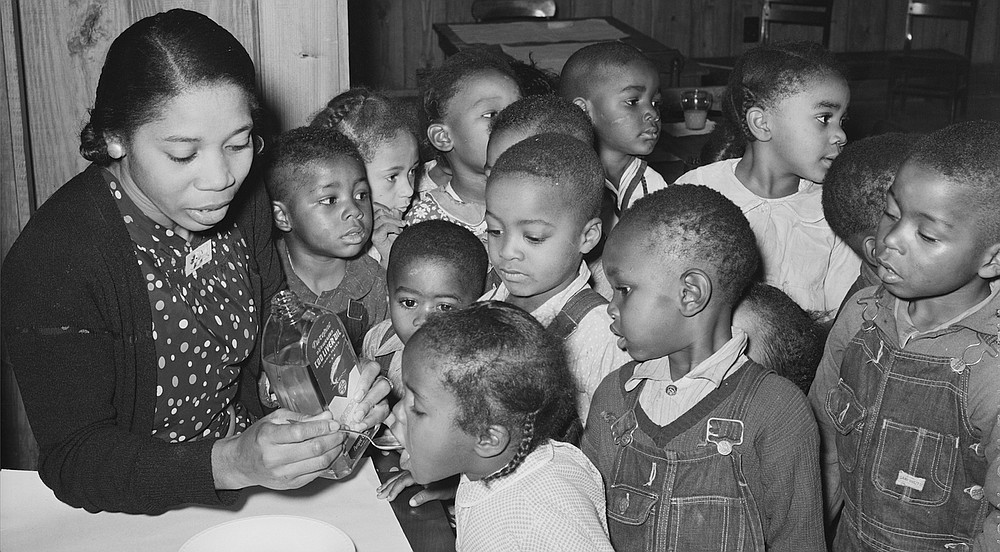
It was time for cod liver oil in the nursery school when Farm Security Administration photographer Russell Werner Lee (1903-1986) visited the Lakeview Resettlement Project, 15 miles southwest of Helena, in December 1938.
(Library of Congress Prints & Photographs Division)
TAMPA, Fla. — Ready or not, Thanksgiving week is here, which means holiday travel is back in full force. With the widespread availability of COVID-19 vaccines for people as young as 5-years-old, travel experts say people are feeling more comfortable and more confident in traveling …
Premier beach-resort brand, Outrigger Hotels and Resorts revealed the bold design and contemporary dining outlets for its newly branded Outrigger Surin Beach Resort. The boutique property facing the powder-fine sands of Surin Beach in Phuket is scheduled to open on 15 December 2021. This welcome …
Guests enjoy the highest Via Ferrata in North America at Arapahoe Basin Ski Area, at 12,999 feet, in … [+] Summit County, Colorado.
Photo: Ian Zinner, Arapahoe Basin Ski Area
Profiling inspiring places, communities and experiences around the world, the new list of “Best of the World 2022” travel destinations from National Geographic celebrates the new, the different and the influential as the pandemic transforms how travelers see the world and what they value most.
For its 2022 list, National Geographic’s editorial teams around the world have selected 25 top destinations that are divided among five categories: Nature, Adventure, Sustainability, Culture and History, and Family. They include a number of World Heritage sites in honor of UNESCO’s 50 years, national parks and wildlife, outdoor activities, green travel and multi-generational adventures and journeys.
MORE FROM FORBESBest Animals, People And Nature Photography: 21 Winners Of Siena International Photo AwardsBy Cecilia Rodriguez
From the ‘next great safari destination’ in Caprivi, Namibia, and the Blackwater National Wildlife Refuge on Maryland’s Eastern Shore, to the ancient tea mountains and traditions of Yunnan, China, and the new Seine River bike trail in France, this year’s list explores inspiring locations.
“While the pandemic stalled many of our travel plans for nearly two years, our appetite for new and impactful journeys has only grown,” said George Stone, executive editor of National Geographic Travel. “In many ways, the pandemic provided a moment for travelers and communities around the world to reflect and regroup on how we explore the world.”
These are National Geographic’s 25 ‘must-see’ destinations for 2022, with partial descriptions. For more information, visit NatGeo.com/BestoftheWorld.
Best Of Nature
Elephants from Caprivi Strip, Bwabwata, Kwando, Mudumu National Park, Namibia
Photo: Radek Borovka, Alamy Stock Photo
The Caprivi Strip in Namibia: A narrow finger of land that juts toward the east in the extreme north of the country, is a green, wildlife-rich territory. The presence of the Okavango, Kwando, Chobe and Zambezi Rivers creates an ideal habitat for numerous animal species.
Lake Baikal, Russia: Baikal is so vast and deep that many locals call it a sea. Covering some 12,200 square miles, the massive lake is a natural wonder.
But it’s also in serious trouble. Although deemed a UNESCO World Heritage site, it suffers ongoing pollution, the recent weakening of government protections and new threats such as large-scale tourism development.
Visitors can help safeguard the lake and its varied landscapes — including tundra, steppe, boreal forest and virgin beaches — by volunteering with Great Baikal Trail Association, a nonprofit environmental group creating a hiking route around the lake.
Tent camping under a rising Milky Way in Voyegeur’s National Park in Minnesota.
Photo: Steve Burns, Gett y Images
Northern Minnesota: Turn off the lights and multiple thousands of stars sparkle in the night sky of this remote region bordering the Canadian province of Ontario. It has has little to no light pollution and residents are determined to keep it that way.
Belize Maya Forest Reserve: The race to preserve one of the largest remaining tropical rainforests in the Americas got a big boost recently when a coalition of conservation partners led by the Nature Conservancy bought 236,000 acres of tropical forest in northwestern Belize to create the Belize Maya Forest Reserve.
Along with saving some of the most biodiverse forests in the world, the new protected area — which is contiguous with the neighboring Rio Bravo Conservation Management Area — closes a huge gap in a vital wildlife corridor that runs from southeast Mexico through Guatemala and into Belize.
Victoria, Australia: Drive the Great Ocean Road to find green shoots of regeneration popping up across Australia where bushfires in 2019 and 2020 burned some 72,000 square miles of land. The disasters led to the deaths of nearly three dozen people and more than one billion animals.
Best For Adventure
Bike trail along canal in Normandy, France.
getty
Seine River Bike Trail, France: La Seine à Vélo is a new cycling trail worthy of painter Claude Monet, whose house and famous water lilies in Giverny are on the route. The 270-mile Paris-to-the-sea path, opened in October 2020, also offers lesser known masterpieces such as the colorful street art of the Canal Saint-Denis in Paris.
On the trail’s 15 stages, bikers pass through protected natural areas, including Normandy’s Grande Noé Bird Reserve, located along a major migratory flyway.
Nepisiguit Trail, New Brunswick, Canada: A turtle-shaped rock near Nepisiguit Falls in the Canadian province of New Brunswick carries with it the legend that once the turtle (named Egomoqaseg, or ‘rock like a moving ship’) is completely out of the water, it will be the end of the world for the Mi’gmaq people.
The falls are a stop along a millennia-old First Nations migration route that has been developed into the longest back-country hiking trail in the Canadian Maritimes.
Running for 93 miles along the Nepisiguit River, the rugged Sentier Nepisiguit Mi’gmaq Trail follows ancient portage pathways used by the nomadic Mi’gmaq.
The Nepisiguit Trail is a 150 kilometer back-country, wilderness hike that follows the historic … [+] Nepisiguit River from its source.
getty
Costa Rica: Stretching across Costa Rica from the Caribbean to the Pacific, the Camino de Costa Rica is a 174-mile-long window into life far off the well-trod tourist path. The 16-stage hiking route mainly follows public roads as it passes through remote villages and towns, Indigenous Cabecar lands and protected natural areas.
It’s designed to spark economic activity in rural districts. Local families, nonprofits, and a network of micro-entrepreneurs such as Ecomiel honey producers, the woman-owned Finca El Casquillo organic farm and La Cabaña sustainable coffee micro-mill, provide most of the trail’s lodging, food, tours, and other hiker amenities.
Freediver swimming among the non-poisonous jellyfish of Jellyfish Lake in Palau.
getty
Palau: Swim with sharks. To help protect Palau’s culture and environment from the negative impacts of tourism, when you arrive the stamp in your passport will include the Palau Pledge, which all visitors must sign, promising that “the only footprints I shall leave are those that will wash away.”
Some 80{e9f0aada585b9d73d0d08d3c277fd760092386ec23cac37d50f4b8cd792b062a} of the nation’s waters — recognized by National Geographic’s Pristine Seas project as one of the richest marine ecosystems on the planet — is preserved as the Palau National Marine Sanctuary. At 183,000 square miles, the no-take sanctuary is one of the world’s largest protected marine areas, safeguarding 700 species of coral and more than 1,300 species of fish, including a dazzling variety of sharks.
Arapahoe Basin, Colorado: One must climb the Rockies, North America’s highest via ferrata, for unparalleled views of the Continental Divide.Arapahoe Basin’s “iron way”— a climbing route comprising metal rungs and cables — begins at the base of granite Rocky Mountain cliffs and ascends nearly 1,200 feet to a 13,000-foot summit.
A glance below reveals a weathered Colorado landscape dotted with green moss, pink and purple flora and rock gardens created by the cliffs themselves, the fallen chunks varying in size from pebbles to Volkswagen Beetles.
Best For Culture And History
A picture shows items of concern to Ainu collected by the first Ainu Diet member, displayed at the … [+] Kayano Shigeru Nibutani Ainu Museum in Biratori Town, Hokkaido.
Photo: Yomiuri Shimbun, AP
Hokkaido, Japan: Two recent museums will teach visitors in Hokkaido, Japan’s wildly scenic and northernmost main island, about the Ainu, Indigenous people from the northern region of the archipelago. The museums are the National Ainu Museum and Park at Upopoy and the Kayano Shigeru Nibutani Ainu Museum.
Marginalized since the late 1800s, Japan’s Ainu were granted legal protections in 2019. Visitors can discover the timely, sustainable-living lessons of the Ainu, whose spiritual beliefs are rooted in respect and gratitude for nature. Just 30 minutes to the southwest, you can soak in nature at Noboribetsu Onsen, Hokkaido’s premier hot springs resort in the Shikotsu-Toya National Park.
Jingmai Mountain, Yunnan, China: This place offers a perfect cup of tea.Located in the remote southwestern corner of China’s Yunnan Province, the region which was a starting point of the legendary Ancient Tea Horse Road, is one of the oldest cultural landscapes in the country and slated to become one of the newest UNESCO World Heritage sites in 2022.
Tin Pan Alley, London: Despite pushback from punk and rock purists, the remix of Denmark Street, former hub of the British music industry, promises to hit all the right notes. Once lined with music publishers, recording studios, rehearsal rooms, and dimly lit clubs, the tiny street nicknamed London’s Tin Pan Alley helped launch the British punk rock movement and legendary figures such as David Bowie, Elton John and the Rolling Stones.
Now this iconic slice of history is being revived as part of Outernet London, the West End’s new $1.2 billion entertainment district.
Procida island harbour, Gulf of Naples, Italy.
getty
Procida, Italy: The island city has been selectedas the Italian Capital of Culture 2022, with the theme La cultura non isola (Culture does not isolate), which now seems particularly on point. Located 40 minutes southwest of Naples via high-speed ferry, city officials plan to use their year in the spotlight to illustrate the importance of culture, particularly in times of uncertainty.
Procida 2022 will run cultural programming such as contemporary art exhibitions, festivals and performances over 300 days to encourage responsible travel throughout the year.
Atlanta, Georgia: At the forefront of social change, this unique American city is the cradle of the civil rights movement, the home of Coca-Cola and of hip-hop culture shaping global culture.
Ecuador Cobalt, a winged Parakeet at Napo Wildlife Center, Yasuni National Park, Quechua, Ecuador.
Photo:
Parque Nacional Yasuni, Ecuador: In recognition of the global importance of the Amazon, France is leading the fight against deforestation in eastern Ecuador’s Yasuní National Park, designated a UNESCO Biosphere Reserve in 1989.
The 4,000-square-mile park, home to mahogany trees, sweet guabas, anthuriums, palms and hypnotizingly green ferns, is the first of five pilot sites in the French-funded TerrAmaz program, a four-year initiative launched in late 2020 to support sustainable development and safeguards biodiversity in the Amazon rainforest of Brazil, Colombia, Ecuador, and Peru.
Yasuní — considered one of the most biodiverse places on Earth — shelters an astonishing assortment of creatures such as anteaters, capybaras, sloths, spider monkeys and about 600 species of colorful birds. In the Napo and Curaray rivers flanking the park, visitors can watch for the Amazon river dolphin, an endangered and enigmatic species.
Ruhr Valley, Germany: Mining and steel production once dominated the densely populated Ruhr Valley in Germany’s western state of North Rhine-Westphalia. Today, the region is repurposing former slag heaps (mounds of mining waste) and post-apocalyptic industrial sites as parks and open-air cultural spaces.
The most famous is the World Heritage site of Zeche Zollverein (Zollverein Coal Mine Industrial Complex), home to an outdoor swimming pool, ice rink and walking trails and part of the wider Emscher Landscape Park, an east-west system of green spaces and corridors covering nearly 175 square miles.
Łódź, Poland: Named a UNESCO City of Film since 2017 for its rich cinematic culture, Łódź, a city of 700,000 in central Poland, was a major textile manufacturing center in the 19th and 20th centuries. Now Poland’s Hollywood is flipping the script on its industrial past to create a greener future.
In recent years, Łódź has embraced new ecological technologies such as using pre-RDF (refuse-derived fuel) and biomass energy to heat homes. Nearly one-third of Łódź is green space, ranging from new pocket parks to the 2,977-acre Łagiewnicki Forest.
In the city’s old industrial areas, factories are being reborn as parks, cultural centers, residences and retail spaces. The trendiest spot on the cultural map is OFF Piotrkowska, a buzzing art, design, dining and club district housed in a former cotton mill.
Hikers and balsamroot on Dog Mountain Trail, Columbia River Gorge National Scenic Area, Washington.
Universal Images Group via Getty Images
National Columbia Gorge Scenic Area, Oregon/Washington: It’s the largest National Scenic Area in the U.S., straddling the Oregon-Washington border and comprising 293,000 acres of public and private lands along the Columbia River Gorge.
The area attracts more than two million visitors a year. A nonprofit alliance is helping to reduce tourist impact on local nature and culture. This collaboration has become a model for other regions building a sustainable tourism economy.
Chimanimani National Park, Mozambique: A conservation success, the park,established in October 2020, is one of Mozambique’s newest national parks. It sits on the country’s mountainous border with Zimbabwe and is home to Mozambique’s highest peak, Mount Binga (elevation: 7,992 feet). It was once flush with elephants, lions, and other large animals whose images appear in ancient rock art created by the ancestral San people.
While poaching during decades of civil unrest decimated wildlife populations, small numbers of elephants remain as do at least 42 other species of mammals and a dazzling variety of plant and avian life. Chimanimani is one of Africa’s great parks rebounding from war.
Best For Family
The Hungarian Parliament and the Chain Bridge in Budapest at sunset.
getty
Danube River Cruise: Boating on the Danube can seem like traveling through a realm of fairy tales with its scrolling views of castles, medieval towns and stately palaces that help to bring European history to life. The river twists through 10 European countries (Germany, Austria, Slovakia, Hungary, Croatia, Serbia, Romania, Bulgaria, Moldova, and Ukraine) and most Danube cruise itineraries include stops in at least four of those, with special family sailings featuring kid-friendly onshore activities.
Granada, Spain: Built as a palace-city by 13th-century Nasrid sultans — rulers of the longest-lasting and final Muslim dynasty on the Iberian Peninsula — the Alhambra (“red fort”) is considered the Moorish architectural jewel of Europe. The almond-shaped profile of this UNESCO World Heritage site rests on a hill above Granada, one of Spain’s most picturesque cities.
The mathematical wizardry on display here is particularly fascinating for families: Intricate mosaics, arabesques (a repetitive, stylized pattern based on a floral or vegetal design) and muqarnas (ornamental vaulting) make the Alhambra a masterpiece of geometric beauty and a colorful classroom for age-appropriate exploration of math concepts, such as shapes, symmetry, proportion and measurement.
Bonaire: Bathed in dazzling sunlight, a turquoise sea, palm trees, white beaches and a laid-back atmosphere, Bonaire is an idyllic tropical destination. Compared to many other Caribbean islands, Bonaire — population 21,000 — is quiet and still relatively wild and unspoiled.
Off its coast lies one of the oldest marine reserves in the world, the Bonaire National Marine Park, a reserve encompassing 6,672 acres of coral reef, seagrass and mangrove vegetation where divers and snorkelers can spot up to 57 species of coral and more than 350 different fish species.
Participants in the fourth International Antalya Yoruk Festival with their donkeys in Antalya, … [+] Turkey.
Getty Images
Lycia, Turkey: The nomadic Yörüks,(literally, “walkers”) originally from different Turkic groups that ranged from the Balkans to Iran, once roamed the plateaus of the Turkish riviera. Now settled down, they have kept many of their thousand-year-old customs alive.
In the historical Lycia region in southwestern Anatolia, Teke Peninsula, Yörüks live a semi-nomadic life with their tents, kilim rugs, herds, shepherd dogs and transhumant traditions, set against a mountainous, Mediterranean backdrop full of olive trees.
In recent years, tour companies have started to merge the marvels of Lycia with Yörük life. Families can trek parts of the famous Lycian Way amd visit ancient sites such as Patara, Xanthos, or Letoon.
But it’s the children who have the most fun as they experience Yörük culture by making syrup with pomegranates, cooking local pastries, milking goats or taking part in the olive harvest.
Eastern Shore, Maryland: The history of the Underground Railroad flows through the waterways, wetlands, swamps and tidal marshes of Dorchester County on Maryland’s Eastern Shore. This is where the secret network’s most famous “conductor,” Harriet Tubman, was born enslaved, grew up and honed the skills such as trapping, hunting, and using stars to navigate that she used to escape to freedom in Pennsylvania.




/https://specials-images.forbesimg.com/imageserve/61969f21e92c7161c5166971/0x0.jpg?ssl=1 "The 25 Top World Destinations For 2022 By National Geographic")