2022 is very likely to be a occupied year for the seashores of Delaware, according to Tina Coleman, communications supervisor for Southern Delaware Tourism. “Everything I have been listening to is telling me that it is going to be an additional file-breaking yr,” Coleman mentioned. …
Now that society is back up and running and Covid-19 restrictions are becoming a thing of the past, travelling is back on the minds of many. Being an eco-tourist and causing no harm to local communities, economies, and the environment is the best way to …
“They arrived to this place hunting for the streets paved with gold, but what they bought was a large amount of antisemitism,” said Alan Kook, her fantastic-great-grandson.
Ravitz managed to invest in land not considerably away in Pennsylvania and commenced to re-build the life she experienced appreciated in Austria, the place she experienced owned a effective farm and supplemented her profits in the winter by taking in traveling circus troupes as boarders, in accordance to Kook. In Pennsylvania, as well, she put up boarders in the summertime, welcoming pals and friends of good friends searching for reduction from the town warmth. She would cook dinner and entertain, styling the farm as a mountain getaway.
Tale carries on below ad
Ravitz was one particular of hundreds of Jewish farmers who thrived with this hybrid farm-inn product in early 20th-century The us. A lot more than 1 million Jews experienced immigrated to the United States by 1924, with several clustering about New York Town. Doing work-course Jews dwelling in cramped tenement properties ended up keen to escape to the countryside in the summertime, but several motels explicitly forbade Jewish attendees. This is how people like Ravitz — and lots of others, scattered around the Catskills, Connecticut and New Jersey — came to run flourishing boarding businesses. Some would sooner or later give up farming to develop their accommodations.
The Jewish Family vacation Information, initially revealed close to 1916, compiled these addresses, along with a complete community of Jewish-owned or Jewish-helpful spots in which it was safe to for Jews to try to eat, rest and check out. This information, and other travel guidance like it posted in the Yiddish push, served as a vital resource in navigating the likely hazard of Jewish travel in early The us. It even went on to inspire the “Green Reserve,” a commonly made use of guidebook for Black tourists.
Antisemitism was widespread in 20th-century The united states. Membership in the Ku Klux Klan noticed a key resurgence in the 1920s, with estimates ranging from 3 million to as lots of as 8 million associates nationwide. When the KKK overwhelmingly targeted Black Americans, Jews also faced frequent discrimination. “No Hebrews or Consumptives Accepted” browse numerous lodge ads in the 1st quarter of the 20th century. “Gentiles only” appeared in hospitality advertising, as did “Christian clientele only.” A review conducted by the Anti-Defamation League in 1957 uncovered that virtually each and every state experienced inns and resorts that barred Jews.
Tale proceeds down below advertisement
The Jewish Getaway Guideline related Jews to a community of spots that did not just tolerate, but welcomed them. Dozens of the listings touted kosher meals, often built with farm-clean butter and eggs. The disorders at some of the rented rooms had been much from luxurious, but they made up for modest choices in hospitality and affordability.
Just one farmhouse ad promised: “You will be designed to feel at house.” The majority of the listings had been created in Yiddish, provided that numerous Jewish People have been immigrants or the young children of immigrants whose primary language was Yiddish.
A huge amount of the attributes have been concentrated in the Catskill Mountains. “This is the genesis of the Catskills as a Jewish vacation location. It definitely started off as a grass-roots factor: persons from the metropolis who wanted to get out of the city in the course of the summer season,” reported Eddy Portnoy, academic adviser at the YIVO Institute for Jewish Study. “When Jewish farmers recognized this could be a beneficial prospect, they began re-creating their very own homes as boardinghouses, or even constructing more houses on their attributes.” The vacation tutorial itself was released by the Federation of Jewish Farmers of The us.
When a lot of of the attributes in the guideline ended up mother-and-pop affairs, by 1917 some of the farmhouses experienced begun to rework into resorts. “The Grand Mountain House” in Sullivan County, N.Y., for occasion, advertised by itself as a “country summer months house with all the up-to-day city conveniences,” which include an orchestra, a casino, billiards, tennis, baseball and a qualified chef.
Tale proceeds under ad
The success of these inns, thanks in part to the guidebook, soared in the following many years. The Catskills grew to become a trip very hot place. Grossinger’s Catskill Resort Resort, for instance, which was 1 of the most productive resorts in the area for a long time, commenced as a dilapidated barn in the 1910s. It transformed into a sprawling 1,200-acre, 35-developing resort, complete with dancing, athletics, lakes and its personal airstrip. Grossinger’s even hosted Eddie Fisher and Elizabeth Taylor’s wedding day.
The information contained not only hotel listings but everything one may well will need on a holiday vacation: car fix, drugstores, grocers, tailors, cobblers and a Kodak images studio. Touring safely was about a lot more than just finding a welcoming hotel. It meant getting ready for a lot of attainable contingencies: No a single wants to come across himself with a damaged-down auto in the mountains, only to be refused support at a garage.
This kind of scenario — refusal of support, or even violent reprisal — was a critical problem in Jim Crow-period The usa, and it influenced the postman Victor Hugo Environmentally friendly to publish a very similar guide for Black people today. In the introduction to his “Negro Motorist Environmentally friendly Book,” Green credited Jewish guides for serving as a template for his e-book, noting that “the Jewish press” experienced “long printed info about destinations that are limited.” Very first released in 1936, the Eco-friendly Ebook likewise detailed lodges, eating places, mechanics, barbershops and nightclubs.
Vacation usually carried a a lot bigger danger for Black individuals than for Jews. As the book’s include warned: “Carry your Environmentally friendly E book with you … you may possibly need to have it … ” Black motorists risked exclusion from “Whites only” areas, law enforcement harassment, physical violence and even lynching. “While we may well be inclined to make analogies concerning antisemitism and anti-Black racism, it’s crucial to recognize where people analogies conclude,” reported Eli Rosenblatt, an assistant professor of religious experiments at Northwestern College. “Jews who had been predominantly of European origin at the time availed by themselves of areas for Whites only.”
The two guides would sooner or later turn out to be obsolete. In 1967, a few yrs following the passage of the Civil Rights Act, the Inexperienced E book ceased publication. It is not clear when the Jewish Getaway Guidebook stopped currently being published, but for Jewish travelers, the enlargement of the Catskills into a sought-after vacation spot in the mid-century meant that they experienced their select of resorts a lot sooner.
When Black and Jewish People the two faced regular discrimination in lodging, they often opened their doors to one particular a further. In the early 1950s, Grossinger’s invited Jackie Robinson, the 1st Black person to engage in key league baseball, to remain for the summer time. Grossinger’s, which started out off as a ramshackle farm giving aid from city pressure and antisemitism, experienced grown into an oasis. The Grossinger family members prolonged the experience of “heimish” — what Portnoy described as a homey coziness — to a guy battling continual discrimination and harassment.
“I doubt that she [Jennie Grossinger] understood or could have absolutely appreciated how important the invitation was to Jack and me in the early Fifties,” Robinson’s wife, Rachel, wrote in her memoir. For their family, there ended up couple of inns “to rival the Huge G.”
Welcome to the VERANDA Weekend Guides, where we exhibit you how to make the most of 48 hrs in our preferred locations. This time, we’ve tapped luxurious journey journalist and founder Dylan Grace Essertier to walk us via a luxe, restorative weekend in Sedona, Arizona. …
A chain of islands surrounded by the waters of the Atlantic Ocean, Key West is a world apart from the mainland. The southernmost city in the continental United States, the sun-soaked outpost treats visitors to a seamless blend of nature, nightlife, and history. Of course, …
Let’s get this out of the way: yes, there’s a national park in Ohio, and yes, it’s worth a visit. As a Clevelander and frequent Cuyahoga Valley National Park (CVNP) visitor, I field these questions a lot—especially from friends who’ve never been to the state. It’s not that my home gets a bad rap in the world of outdoor adventure. It’s that, compared to other Great Lakes states, it hardly has a rap at all.
Michigan’s Upper Peninsula is lauded as a booming MTB hub. Minnesota boasts pond hockey and winter bike trails. Ohio? It’s best known for the burning Cuyahoga River—but it also has 2021’s 13th-most-visited U.S. national park. CVNP, just 30 minutes south of Cleveland, drew 2.5 million visitors in last year. That’s more than Utah’s Bryce Canyon (2.1 million). But unlike those hoodoo-dotted landscapes, this park takes a different approach. Its sandstone gorges, profusion of waterfalls, and hemlock and oak-fringed waterways are dazzling. But they’re not the main reason to visit.
“CVNP represents taking back the natural world via conservation,” says Josh Scott, founder of the Cleveland Outpost, a gear-exchange shop serving northeast Ohio. When its 33,000 acres first became the Cuyahoga Valley National Recreation Area in 1974, the region’s natural wonders were being overlooked. Cleveland was an industrial powerhouse in the 19th and 20th centuries, and with that came loads of pollution. During those years, the Cuyahoga River had become so oil-drenched due to runoff that the river burned not once, not twice, but 13 times.
The blaze in summer 1969 did more than make national headlines. It set in motion the creation of the Environmental Protection Agency and the Clean Water Act, and further catalyzed the emerging environmental movement of the ‘60s. After decades watching the demise of their natural resources, local environmentalists rallied to protect this stretch of land between Cleveland and Akron. Nearly 50 years later, their work continues to pay off.
Wetland cleanups have led to a remarkable wildlife resurgence. While unheard of mere decades ago, it’s commonplace to see beavers and bald eagles here. And, with recent dam-removal projects, the river now booms with great blue heron, steelhead trout, and northern pike. For the first time since the creation of the EPA in 1970, federal officials deemed the river’s fish safe to eat (within reason, of course).
That’s why, when people raise an eyebrow at my love for CVNP, I lift my eyebrow right back. “This park doesn’t exist to entertain you as a tourist,” says Scott. “It exists to be a model of conservation, and it’s one of the best in the world for that.”
What You Need to Know Before Visiting
(Photo: yenwen/Getty)
It’s a park for the people. CVNP is not your average national park—and its setup makes that clear. Instead of one vast, unspoiled stretch of wilderness, it’s a patchwork of protected land parcels. One moment you’re driving through the woods, the next you’re outside park bounds in a neighboring community. Why the confusing road map? In addition to protected gorges, forests, and waterways, the unit has working farms and numerous homes within park limits, including the quaint gateway town, Peninsula.
It’s accessible and easy-to-navigate. Lost? Don’t sweat it. Cell service is plentiful. Additionally, nearly all trailheads have a bathroom (and if they don’t, there’s inevitably one just down the road). Picnic areas and shelters also abound throughout, as do accessible visitor options, from wheelchair-friendly trails and fishing piers to guides and exhibits offered in braille.
A visit means fresh produce. Yet another reason CVNP isn’t your average national park: People don’t just visit here, or live here—they farm on this land, too. Agriculture is in Ohio’s DNA, and the park’s Countryside Initiative, launched in 1999, preserves the valley’s pastoral landscape and farming culture. Today, the 10 operating farms integrate sustainable growing practices and sell fresh fare via year-round in-park markets.
How to Get There
(Photo: Douglas Sacha/Getty)
With Interstates 77, 70, and 271 running near and through the park, driving is the best way to reach and explore it. Along with being 30 minutes by car from downtown Cleveland, it’s also just a 15-minute trip from Akron, Ohio’s fifth-largest city, located just south of CVNP.
For air travel, head to Cleveland Hopkins International Airport. From there, head down I-71 and across I-80 to reach the park’s gateway town, Peninsula. Take Riverview Road north of Peninsula to reach the Boston Mill Visitor Center.
The Best Time of Year to Visit
(Photo: Paul L. Csizmadia/Spec3 Photography/Getty)
Given that Cleveland’s a four-season city, choosing when to visit Cuyahoga Valley depends on the adventure you’re after. Here’s what to expect throughout the year.
Spring
Spring can be a beautiful time to visit, with plenty of wildflowers, rushing waterfalls, and crisp temperatures in the 40s and 50s. It often snows into April, so for an easier excursion, plan for a late May trip, and pack layers just in case. When the weather does cooperate, try the Brandywine Gorge Trail or Haskell Trail to see the most vibrant wildflower displays.
Summer
Summer brings the biggest crowds—and for good reason. Farmers markets reopen. Live music at outdoor amphitheater Blossom Music Center resumes. And temperatures in the 80s and 90s attract hikers who’d been hibernating from Cleveland’s late-spring chills. In July and August, it’s best to visit around sunrise or sunset to avoid the heat and humidity, though dense hardwood forests of oaks, pines, and maples provide ample shade for midday excursions.
Fall
Bookmark October for peak leaf peeping, and head to fall-foliage vantage points like Ledges Overlook, the Brandywine Gorge Trail, and the Cuyahoga Valley Scenic Railroad’s fall-flyer trip to see what the autumn frenzy is all about. Temperatures hover between 60 to 70 by day, and can plummet to 30 or below at night.
Winter
Winter in this part of the state is not for the faint of heart. Lake-effect snow from neighboring Lake Erie brings unpredictable weather, not to mention around 61 inches of annual snowfall with temperatures from the 30s down to the teens. If you’re looking for fresh powder in the Midwest, the park has plenty of cross-country skiing and snowshoeing options, with rentals available at Boston Mill Visitor Center. CVNP also has its own Brandywine and Boston Mills Ski Resort (day passes from $50), a low-key hill where even the black-diamond runs are a breeze for intermediate skiers.
Where to Stay in or Near Cuyahoga Valley National Park
Camping
As of 2022, camping is not allowed within CVNP due to administration issues, according to local officials. For nearby camping, head up to the deep green forests of Brecksville Reservation, another wilderness escape just across the park’s northern boundary. Here, reservations ($5) unlock access to three backcountry sites. Try another unique Cleveland-area camping experience at Lake Metroparks’ primitive campgrounds, an hour southwest from the park. These secluded tent campsites sit atop the Lake Erie bluffs, offering gorgeous sunset views.
Within the Park
For lodging within the park, book the centuries-old Stanford House (from $400). This nine-bedroom rental, the former home of farmers, is steps from the famed Towpath Trail, a 87-mile bike path that bisects CVNP and follows the historic Ohio & Erie Canalway, which linked the northeast part of the state to the east coast. Then there’s the Inn at Brandywine Falls (from $175). Erected in 1848, this six-room bed-and-breakfast adjacent to a waterfall has quick trail access right from the property grounds.
Beyond the Park
For more options, overnight in Cleveland. Try Aloft Cleveland Downtown (from $135) in the city’s hip Flats district, situated along the Cuyahoga River’s crooked northwest terminus. The Flats, once dense with factories and smog in the mid-1900s, looks nothing like its polluted past. Trendy hangouts like BrewDog and Collision Bend Brewing Company, plus hotels, and recreation outfitters, have replaced those industrial-era eyesores.
What to Do in Cuyahoga Valley
(Photo: Douglas Sacha/Getty)
Hiking
A web of more than 125 miles of trails means there’s no shortage of excursions to suit every timeframe and skill level. For an afternoon hike, hit the two-mile Pine Grove Trail. This kid-friendly route shows off the park’s diverse flora, with wildflowers at ground level and lush green hemlocks and oaks above.
Nearly 40 miles of the state-wide Buckeye Trail pass through the park, with waterfalls and dramatic ledges as the backdrop. Most hike the 1,444-mile loop in sections versus a full-on thru-hike. One of the most scenic shorter stretches is this eight-mile route up and down some of the park’s hilliest terrain. It travels through dense forests, waterfalls, and creeks, before joining the Towpath Trail for an easy return.
To feel dwarfed beneath towering sandstone cliffs, hit the Ledges Trail, the park’s most hyped. This two-mile path features offshoot caves and boat-sized boulders, with the kind of jaw-dropping scenery many out-of-towners don’t envision when they picture Ohio. No trip is complete without admiring the thunderous Brandywine Falls, where water rushes down 60 feet into a namesake creek. Snag the best vantage point via the lower deck of the boardwalk or take the 1.5-mile Brandywine Gorge Loop to see this bridal-veil waterfall from multiple angles.
Dog adventurers, you’re in luck: Pets are allowed on 110 of CVNP’s 125 miles of hiking trails, making it one of the country’s most dog-friendly national parks.
Cycling and Mountain Biking
Roughly 20 miles of northeast Ohio’s multipurpose Towpath Trail ribbon through the park. The full 87-mile route starts in downtown Cleveland and winds south through CVNP, past Akron, and on to New Philadelphia. You can bring your own bike, or rent them through Century Cycles in Peninsula.
If mountain biking is more your speed, hit up the park’s MTB route: the East Rim Trail system, which connects with the Towpath Trail just south of the Boston Mill Visitor Center. This ride features two main loops and two side trails that total just over seven miles. Those who really want to get their fill can head to the Bedford Reservation, eight miles northeast, with nearly 10 miles of loops. Or, drive 30 minutes north of CVNP to Ray’s Indoor Bike Park, a 165,000-square-foot MTB playground. It’s open during the off season, form October through April.
Paddling
In 2020, the Cuyahoga River got a serious facelift: the removal of two dams let the river flow freely between the park and Cleveland for the first time in nearly 200 years. The full water trail spans 21 miles, and requires a full day of paddling. But kayakers can also enjoy shorter outings with the park’s Cuyahoga Valley Scenic Railroad’s (CVSR) kayak-aboard service (starting at $10), available on the Explorer train from June through October. For a 16-mile paddle trip, park at Lock 39 then take the train south to Lock 29. A roughly five-hour forested journey will lead you back upstream to your car. Take a shorter 10-mile version of this trip from Lock 29 north by parking and catching the train at the Station Road stop in Brecksville. Note, you won’t find rentals within CVNP, but you can book kayaks via Cuyahoga Valley Adventures, which also offers guided trips just south of the park in Akron.
Train Rides
The Cuyahoga Valley Scenic Railroad (CVSR) provides more than kayak and bike-aboard train trips. This rail line, which carried coal and passengers for more than a century, now offers a host of sightseeing and entertainment rides, complete with a free audio tour via the CVSR app. The roundtrip trip lasts three hours, and follows the length of the park from the town of Independence to Akron, with a handful of stations along the way. In addition to its regular year-round operations, themed rides offer a unique train experience you won’t find in other national parks, including a murder-mystery experience, cocktail-tasting excursion, and the annual holiday celebration, North Pole Adventure.
Wildlife Viewing
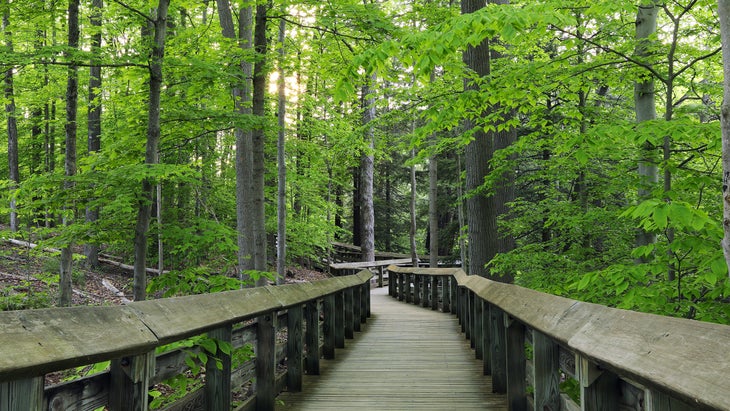
See rewilding in action at one of CVNP’s conservation vantage points: the Beaver Marsh, a peaceful wetland with a boardwalk. Before it became a park, this stretch was home to an old auto repair shop that dumped cars in the unused wetland. In 1984, Sierra Club volunteers launched a massive cleanup effort to save it. Beavers, who’d been gone from this area for a century after being over hunted for their fur, didn’t just return to this marshy area—they revived it. The beavers built dams that ended up flooding roughly 70 acres, recreating the wetland ecosystem it once was, and now home to animals like turtles, heron, and beavers. This boardwalk also links to the Towpath Trail.
The Best Places to Eat and Drink Around the Park
We’ll see your soaring snow-capped mountains and raise you a winery on national-park land. What CVNP lacks in those quintessentially dramatic landscapes, it makes up for with one-of-a-kind quirks—starting with Sarah’s Vineyard, which grows nine varieties of grapes and serves up delicious wood-fired pizzas and live outdoor music. For some grub outside of the park, try Pierogies of Cleveland, just west in the town of Richfield. The quick-service Polish diner offers a whopping 30 creative flavors, like yam and walnut, buffalo chicken, and goat cheese and mushroom. Grab a post-hike brew at the Winking Lizard in Peninsula, where you’ll find hundreds of local, regional, and national beer choices.
If You Have Time for a Detour
(Photo: Yuanshuai Si/Getty)
CVNP is a doable day trip, so you can and should spend the rest of your visit embracing another northeast Ohio gem: Lake Erie. This enormous body of water, the sixth largest in North America, has a surface area of roughly 9,990 miles. At first glance, it looks like an ocean—and on its best days, it acts like one, too. Strong winds and the right swells can bring waves of up to 10 feet to its shores, and those conditions have created an unexpected subculture of Great Lakes surfers. This growing community spans all five lakes, from the winter warriors up in Marquette, Michigan, to the Chicagoans who hit Lake Michigan.
In Cleveland, it’s tough to beat downtown’s surf hub, Edgewater Park. Non-surfers can hit the lake for paddling, angling, and even scuba diving. The park spans 147 acres, with 9,000 feet of shoreline, including a swimming beach and dog beach. It kicks off the city’s 17-mile Lakefront Bikeway, which links up with the Flats, downtown Cleveland, and beyond. If you have your pup in tow, this detour-to-your-detour is for them. Stroll from Edgewater up to the budding Battery Park neighborhood, where Terrestrial Brewing Company treats dogs as well as its drinkers: count the adjacent dog park and Sunday “Doggie Brunch” special as proof.
How to Be a Conscientious Visitor
(Photo: Anna Gorin/Getty)
There’s no need to leave a trace in CVNP; virtually every trailhead and parking lot has a trash can and restroom onsite. Even so, the Conservancy for CVNP nonprofit recommends that visitors stay on designated hiking trails and keep a distance from wildlife; visit the Boston Mill Visitor Center for maps and a 3D tabletop model to familiarize yourself with the park’s geography.
Scott suggests another way to leave the area better than you found it: “I think every visitor should go and spend some dollars in Peninsula,” he says. The gateway village of Peninsula is the heart of CVNP; grabbing a drink or enjoying a bite in Peninsula isn’t just good for you—it’s good for the community. How’s that for incentive to indulge?