SAN FRANCISCO (KGO) — The pandemic is slowing down, so vacation is wanting up, but what will it expense you to choose that excursion? 7 On Your Side’s Michael Finney questioned 3 experts: Kelly Rizzo, host of Eat Travel Rock and spokesperson for Hotwire, Willis …


 The Pink Shell Resort is functioning very well around 80{e9f0aada585b9d73d0d08d3c277fd760092386ec23cac37d50f4b8cd792b062a} occupancy this summer months as a fast paced year on Fort Myers Beach front has ongoing as a result of July. / File picture by Nathan Mayberg The Pink Shell Beach …
Peter Kern watched the collapse of the Twin Towers from his office window in New York’s Tribeca neighbourhood. “I saw the fallout from the first building, watched the plane hit the second building, and then watched again as they both fell. It’s an image you never forget,” he says.
In the immediate aftermath of 9/11, friends and colleagues of Kern, who then worked at consultancy Alpine Capital, moved out of New York and warned that they would never travel again.
“Everyone was, like, ‘Oh my God, it’s the end of the world, no one will ever get on a plane again or ever come back to New York again.’ And then two years later [there was] the biggest boom time in New York for real estate [that lasted] for the next 20 years, plus everyone got back on planes and had the biggest numbers that they’ve ever had.”
Covid-19 has been described as the greatest ever crisis for the travel industry, as indeed was 9/11. But Kern, now chief executive of Expedia, one of the world’s largest travel booking companies, applies the same logic to the recovery of travel after the terror attacks to the Covid-19 pandemic: “I tend to think things will be the same.”
Over the past 18 months, the travel industry has been all but shuttered during successive lockdowns, only opening up briefly before rising infection rates forced authorities to close borders again.
Companies have had to load up on debt or turn to governments for handouts. Tui, Europe’s largest tour operator, has received €4.3bn in loans from the German state bank KfW since the onset of the pandemic, while US airlines have had more than $60bn in government aid. Even the stronger travel companies have had to raise cash, fire staff and shrink operations. Expedia reduced its global headcount by 3,000 people to about 19,000. British Airways cut its workforce by nearly a third. Hilton, traditionally seen as one of the strongest hotel groups by analysts, has cut 2,100 jobs and issued $4.4bn in bonds.
The crisis has been felt unevenly across the world. Vibrant domestic travel markets in the US and China have periodically returned to near-normal levels, while a digital travel pass that made border checks smoother helped continental Europe’s summer season. Elsewhere, strict border rules stifled travel into and out of the UK, while in large parts of Asia-Pacific there has been almost no international tourism for 18 months.
You are seeing a snapshot of an interactive graphic. This is most likely due to being offline or JavaScript being disabled in your browser.
The spread of vaccinations, however, means that most countries are now loosening restrictions, and businesses can begin to inch back to profitability. Even Australia, one of the first countries to introduce mandatory hotel quarantine for arriving travellers, has started to welcome vaccinated international arrivals without requiring an isolation period.
“The recovery has really taken shape in the last few months as people have [become] comfortable and can do more in destinations,” says Dan Wasiolek, an analyst at Morningstar. “People had to get comfortable with flying again [after 9/11]. There was that pure aspect [of fear] in the same way there was that pure aspect of health this time.”
For an industry that has lost more than $6tn in the pandemic, according to the World Travel & Tourism Council, the next critical stage in that recovery comes on Monday with the full reopening of the transatlantic flight path for travellers from 33 countries including the UK and most European nations.
Only a select number of approved business travellers and US residents have so far been able to traverse the Atlantic during the pandemic and the resumption heralds the return of the most lucrative air routes in the world, worth $9bn a year in revenues to US and UK carriers before the pandemic.
To celebrate, British Airways and Virgin, two airlines that are heavily reliant on transatlantic travel, will briefly set aside their rivalries and take off simultaneously on flights from Heathrow airport to New York on Monday morning. But beyond the hoopla from the travel industry over pent-up demand and future bookings — epitomised by the reopening of the transatlantic route — fundamental questions over the speed and shape of its recovery are proving difficult to shift.
The near future for the industry looks fragile amid volatile border rules and spikes in Covid cases, acute staff shortages, rising costs and growing concerns about its environmental impact. Technology can perhaps help to offset some of these areas, say industry experts, but many predict that overall revenues will not be back to pre-pandemic levels until mid-decade at least.
Among travel executives, analysts and investors there is a more urgent question: how much will travel change?
“In our mind, the world is totally different because of the pandemic,” says Brian Chesky, chief executive of Airbnb, the accommodation booking platform. He describes it as “one of the biggest changes to daily living since World War Two . . . This to me is a revolution, I don’t think travel is going back to where it was because I don’t think the world is going back to where it was.”
Come fly with me
In the 24 hours after the White House’s announcement that the US would reopen its borders, bookings for flights between the US and UK jumped 140 per cent compared to the week before, according to the travel distribution company Travelport. Yet totals for US-bound flight bookings for December are still only 18 per cent up on December 2020 and are 71 per cent lower than December 2019.
Passengers entering the US will still need to prove they are fully vaccinated and have recently tested negative for Covid-19, underlining how travel is still far from normal even as the industry begins to recover. Executives fear that these types of testing rules will suppress the recovery, and are pushing for vaccinated people to be able to travel without any checks or tests.
John Holland-Kaye, chief executive of London’s Heathrow airport, expects a “reasonably steady” recovery but warns that travellers need to “get used to flying again” and expensive testing rules will hold customers back.
According to the UN World Tourism Organization recovery tracker, air reservations between January and October 2021 languished 86 per cent lower than the same period in 2019, while in July international arrivals were only a third of what they had been in the same month in 2019. Nearly half of the travel executives the tourism body surveyed in June thought the industry would not recover to pre-pandemic levels until 2024 at least.
Travel has always been a volatile industry exposed to external shocks, including economic cycles, oil price rises and geopolitical instability. But it has also proven to be highly resilient: airlines have gone bankrupt, merged and struggled for profitability over the decades, yet the number of people travelling has grown exponentially.
In the years after the 9/11 attacks, successive terror threats and increased security at airports triggered greater anxiety among travellers and a marked fall-off in traffic.
Yet, by the mid-2000s the sector was back to robust health. It hit another significant dip after the 2008 financial crash, but was transporting 1.5bn passengers, more than at any time in history, before the pandemic struck, according to the UNWTO. The numbers were bolstered by growing middle classes in the developing world.
“The trouble is [that] when our industry suffers a shock, it tends to suffer a much bigger shock than other industries. But we are agile and things are coming back,” says Julia Simpson, president of the World Travel and Tourism Council. “We are seeing light at the end of the tunnel and things are beginning to bounce back because people ultimately really, really want to travel.”
Kern frames the recovery in blunter terms: “If a place opens up, people are going there. If it stays closed, people aren’t going there. There’s no magic”.
Business travel, but not as we know it
Airbnb laid off 1,900 of its 7,500 staff in May 2020 before completing a blockbuster stock market listing in December that valued the company at $86bn. In the post-pandemic world it is operating on the assumption that video conferencing and homeworking are here to stay and that travellers are changing their approach to trips, extending business jaunts into holidays and choosing to work from more exotic locations.
“We believe in a world where people have new found flexibility they haven’t had before,” Chesky says.
He, and others in the hotel industry such as Marriott boss Tony Capuano, believe that this will drive people to take longer trips where they combine leisure and work and that business meetings will largely move online. It hinges on remote working leading to a new form of business travel where employers organise off-site meetings in hotels to bring employees from disparate locations together.
Chesky says that Airbnb, which on Thursday reported that stays of 28 days or more were its fastest-growing area, will go from being a short-term rental business to a “travel and living” company that hosts people for months at a time. It is upgrading its website and app to encourage longer stays and more hosts to sign up.
Some companies, including Procter & Gamble, Ford and PwC, have said that they will make remote working a permanent option for staff, while others such as Lloyds Banking Group and S&P Global have announced plans to cut carbon emissions by reducing business travel, in order to meet climate targets.
The belief that we are set to witness a permanent drop in business travel — an industry overall worth $1.4tn in 2019 and a major driver of profit for long-haul airlines like British Airways — is not shared across the industry.
Kern says that while executives may not “take the red eye for the one-day meeting”, he thinks it is “largely going to come back”. Chris Nassetta, chief executive of Hilton, which reported a recovery of short-stay business travel to 75 per cent of pre-Covid levels in the three months to the end of September, says “it’s all well and good not travelling . . . until Goldman Sachs loses three IPO deals to Morgan Stanley because their bankers were on Zoom calls and Morgan Stanley was out [there].”
You are seeing a snapshot of an interactive graphic. This is most likely due to being offline or JavaScript being disabled in your browser.
Holland-Kaye of Heathrow says that he has been “surprised by how strong the business market has been coming back”, while British Airways has seen demand for corporate travel pick up since the US said it would reopen its borders.
“The front end of the plane is the busiest, that’s good news for airlines because that is the most profitable segment,” he says. “But I think the mix that we have been used to, about a third business, a third leisure and a third visiting friends and relatives, I think that is probably where we will end up.”
Impact of climate change
Long term the environmental damage of travel will prove a bigger hurdle to overcome than even the ravages of the pandemic, say many in the industry. With climate figuring in people’s travel decisions as much as cost, location and service in the future.
“If you prioritise the concerns of travellers,” says Vassilis Kikilias, the Greece tourism minister, “the first one is safety and security and right after that it [will be] sustainability for many years. Travellers want to see a readiness and a sensitivity in regards to [the] climate.”
Expedia and its rival Booking.com are working on ways to show customers the environmental impact of their booking in the same way that websites show the star rating of hotels, while Google’s flight search tool already shows the carbon emissions of journeys alongside the price.
Ahead of the COP26 climate summit, flight operators and travel companies unveiled a blizzard of pledges and net zero commitments in an attempt to neuter any argument that we should fly less or that governments should introduce carbon taxes to control demand. BA’s owner has promised to invest $400m in sustainable aviation fuels over the next 20 years to help the industry hit a 2050 net zero target, while even proudly penny-pinching Ryanair has opened a sustainable aviation research centre.
Cruise lines such as Royal Caribbean and MSC have announced plans for hybrid-powered ships and carbon offsets.
The industry hopes these promises of technological investment will be enough to ensure the sector’s continuing growth. Even though some European countries are discouraging domestic flights, including France which has banned many internal flights, Robert Courts, the UK aviation minister, says that “flying isn’t the problem, emissions are the problem” and that technology will eventually allow “guilt free flying”.
Courts was speaking in the week that the UK government surprised many by halving the tax on air passengers for domestic flights just days before the opening of COP26 in Glasgow.
Ever the optimist, Ryanair’s chief executive Michael O’Leary believes that neither the pandemic nor climate change will have “any lasting impact” on flying: “The idea that post Covid people will never travel again, or post COP people will stop flying or flight shaming? [Its] never going to happen.”
Both Thanksgiving and Christmas are heavy-travel holidays, but which one is the cheapest? Here’s our answer. With holiday times approaching, many Americans book their flights to celebrate with their families and friends during the most beautiful time of the year. While air travel suffered its …
The getaway journey period is anticipated to abide by the identical sample as the chaotic summer months, and you need to expect a number of surprises. You just can’t predict them, but you can get ready for them and that includes averting scams. With flights, …
Snowboard instructor Lorraine Lam on how to pack your ski bag for a plane trip
If you are gearing up to head out on a big ski excursion, you are in for a terrific time. There is practically nothing fairly like chasing contemporary tracks in deep snow, and just about every avid skier is familiar with that traveling to a considerably-off location can make you truly feel like a child on Xmas early morning.
Reserving your ticket is one thing, but packing for your ski journey can be a little complicated for any one without the need of practical experience and it can be even a lot more overwhelming if it’s a loved ones ski journey. Below, I’ll show you how to pack a ski bag for air travel so you can provide every thing you want to make the most of your time on the mountain.
“Flying to a far-off place can make you feel like a kid on Christmas morning”, claims Lorraine Lam
The importance of packing thoroughly
Ski journeys are thrilling, no make any difference what style of transportation you are using to the mountain. But air journey arrives with two substantial variations from driving – you have restricted place to pack points, and your devices will be in the arms of others.
With minimal area, you need to be strategic with every product you pack in your ski bag. If you want to preserve factors light, you need to only bring the necessities (which I’ll get into shortly). This will make the packing procedure additional streamlined and a lot easier to entire.
You also need to hold the perfectly-remaining of your ski machines in intellect when packing. You under no circumstances know how baggage handlers will take care of your bag, so you want issues to be nicely packed to incorporate excess cushion and make sure nothing at all will get ruined together the way.
Select a good bag
1st items first, a good ski bag is crucial for anyone touring by air with their ski machines. Skis are a fairly uncomfortable merchandise to pack, and a bag designed exclusively for the occupation will keep everything lined and protected from injury as a lot as achievable.
There are a couple of diverse varieties of ski luggage out there, from essential selections to full-on ski suitcases. For air vacation, I highly propose that you get a big product to carry your skis, boots, poles, and outfits so you can pack every little thing into a single bag and maintain it uncomplicated.
A significant-excellent bag will have powerful development and a great deal of padding to retain your devices shielded from problems. Possessing roller wheels is awesome so that you can get your bag all over quickly, but this isn’t necessary.
The necessities
Now that you have a great ski bag that meets your requirements, it is time to fill it up with all your gear and tools. I have a simple rule that will help me pack efficiently, and it’s an significant one particular to observe if you want to continue to keep things light and uncomplicated:
Only pack what you truly want. Only pack what you are going to use.
This indicates you need to bring only the essentials with you. You obviously need to have all of your ski equipment, like skis, boots, and poles. Then you will need your heat-climate clothing: jacket, trousers, base layer, mid-layer, socks, gloves, goggles, helmet, and beanie.
You are going to possibly want a couple outfits for hanging out at the vacation resort or all over town and some cozy clothes to lounge in following a extended working day on the slopes. You also will want to bring toiletries and personalized merchandise like your digital gadgets.
You really do not need a lot else for the ordinary ski vacation other than what I just outlined earlier mentioned. The considerably less you carry, the much easier it will be to pack, stay arranged, and expend your time in the snow.
How to pack your ski bag
Once you have your bag and all of the critical things out, it’s time to get them completely ready for your excursion.
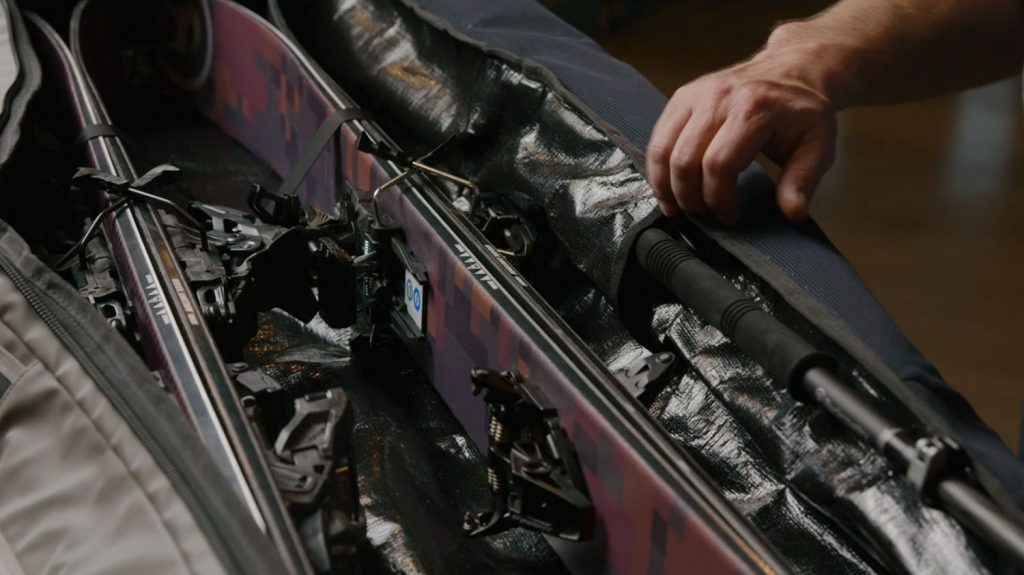
Put your skis, boots, and poles into the bag initial since they just take up the most area and are also the most crucial.
You can lock your skis together utilizing their ski brakes, just like you ordinarily would. I also endorse applying a ski strap to make confident they remain collectively though traveling. If your bag has straps to hold the skis in area, make sure to use those to your benefit as well.
You can lock your skis alongside one another employing their ski brakes
Up coming, come boots and poles. Poles should match following to your skis, and I like to maintain them secured jointly someway as perfectly. You can use a weighty-duty rubber band, velcro strap, or even string to do this.
Boots can be a little difficult to in shape in properly, but a superior ski bag will have a dedicated boot compartment that would make matters a lot easier. To save place, pack the boots puzzle-piece design and style so that the major of a person boot sits on the foot of the other boot, and vice versa.
Put your helmet in upcoming due to the fact that ought to be the very last greater merchandise that takes up a lot more house than the rest of your gear. You can help save a little home by filling your boots and helmet with socks or apparel that matches within of the open spaces.
Then you can fill in the rest of the bag with all of your outfits. I like to use some of my outfits to give my skis and boots additional padding. This assists to make certain they continue to be risk-free and protected all through the flight.
Cram soft things all all around these, just not automatically your jacket or pants since you never want to rip just about anything. The tough edges of your boots and skis can tear outfits through travel, so take into consideration that as you pack.
Clothing is rather uncomplicated to pack, and I constantly like to roll up issues instead than fold them due to the fact this matches a ski bag’s extended, skinny condition. A person other tip I have is to pack your goggles in your particular merchandise on the plane, so they do not get ruined – far better safe than sorry!
Last thoughts
Packing a ski bag for air vacation is not that challenging, but keeping the solutions above in brain can maintain your gear protected and support you provide everything you want and need for the trip. The most vital thing to continue to keep in thoughts is to pack light and deliver only what you actually require.
GIVEAWAY
Acquire a Yuki Threads Southbound Jacket or Bib created from 100{e9f0aada585b9d73d0d08d3c277fd760092386ec23cac37d50f4b8cd792b062a} recycled cloth
We’ve teamed up with the substantially-cherished and environmentally responsible Yuki Threads to present you a Southbound Jacket or Southbound Bib & Brace.


 Acquire a Yuki Threads Southbound Jacket or Bib created from 100{e9f0aada585b9d73d0d08d3c277fd760092386ec23cac37d50f4b8cd792b062a} recycled cloth