Channel Nine’s Travel Guides star Stacey ‘Stack’ Wilburn remaining devastated as her whole dwelling burns down with ‘everything’ her loved ones owns inside By Nicole Douglas For Day by day Mail Australia Published: 00:43 EST, 12 January 2022 | Updated: 03:07 EST, 12 January 2022 …
Highway excursions will continue being the top rated mode of journey all through the vacations in spite of gasoline costing $1.25 for each gallon much more than a calendar year back, in accordance to AAA. Nevertheless, air vacation is projected to increase by 184{e9f0aada585b9d73d0d08d3c277fd760092386ec23cac37d50f4b8cd792b062a} this …
Editor’s Note — Sign up for Unlocking the World, CNN Travel’s weekly newsletter. Get news about destinations opening and closing, inspiration for future adventures, plus the latest in aviation, food and drink, where to stay and other travel developments.
(CNN) — Canada was moved to the US Centers for Disease Control and Prevention’s highest-risk category for travel on Monday.
The world’s second-largest country by total area, Canada has seen a steep rise in cases as the Omicron variant spreads. The country recorded 294,437 new cases for the week ending January 8, according to Johns Hopkins University figures, its highest weekly total of the pandemic.
Canada was joined by one other destination — the Caribbean island of Curaçao — in moving up to the CDC’s Level 4: Covid-19 Very High category on Monday.
The CDC places a destination at Level 4 when more than 500 cases per 100,000 residents are registered in the past 28 days. The CDC advises travelers to avoid travel to Level 4 countries.
Canada had previously been at Level 3 since August 30, 2021. Curaçao, a self-governing country within the Kingdom of the Netherlands, had been at Level 3 since November 22, 2021.
Most international visitors to Canada are required to be vaccinated and to have a negative Covid-19 test result.
Pastel colored buildings line the waterfront of old town Willemstad, Curaçao. This Dutch island has been moved up to risk Level 4 by the CDC, joining ‘ABC’ sister islands Aruba and Bonaire.
Daniel Slim/AFP via Getty Images
In addition to new entries Canada and Curaçao, some of the biggest travel names remain firmly lodged at the CDC’s Level 4 for now:
• France • Iceland • Ireland • Italy • Netherlands • Portugal • South Africa • Spain • Switzerland • United Kingdom
More than 80 destinations were rated Level 4 as of January 10. You can view the CDC’s risk levels for global destinations on its travel recommendations page.
The CDC does not include the United States in its list of advisories, but it was color-coded at Level 4 on January 10 on the agency’s map of travel risk levels.
In its broader travel guidance, the CDC has recommended avoiding all international travel until you are fully vaccinated.
Cruising
The Norwegian Gem, owned by Norwegian Cruise Line Holdings, is moored at PortMiami in August 2021.
Joe Raedle/Getty Images
Level 3 additions
The Level 3 category — which applies to destinations that have had between 100 and 500 cases per 100,000 residents in the past 28 days — saw 10 new additions on Monday from a variety of regions:
The Level 3 designation was actually good news for Armenia and Belarus, which had previously been at Level 4.
It was also good news for Lesotho and Zimbabwe, two of eight southern African countries that landed at Level 4 at the end of November after the Omicron variant was discovered in the region. The US travel ban affecting those countries was lifted on December 31.
It was a move in the wrong direction for Bahrain, Cape Verde, Ethiopia and Zambia, which had been at Level 2. The United Arab Emirates jumped up two risk levels from Level 1.
And Singapore, which was listed as unknown last week because of a lack of information, moved into Level 3.
Level 2
Destinations carrying the “Level 2: Covid-19 Moderate” designation have seen 50 to 99 Covid-19 cases per 100,000 residents in the past 28 days. That level saw eight new additions Monday, five of them in Africa:
• Democratic Republic of the Congo • El Salvador • Fiji • Kuwait • Liberia • Rwanda • São Tomé and Príncipe • Togo
Level 1 and Unknown
In the category of “Level 1: Covid-19 Low” destinations, fewer than 50 new cases per 100,000 residents have been logged over the past 28 days. There were no updates to that category on Monday.
Finally, there are destinations for which the CDC has an “unknown” risk because of a lack of information. Usually, but not always, these are small, remote places. No new destinations were listed in the “unknown” category on Monday.
Considerations for travel
Transmission rates are important to consider when making travel decisions, but there are other factors to weigh as well, according Dr. Leana Wen, a CNN medical analyst, emergency physician and professor of health policy and management at the George Washington University Milken Institute School of Public Health.
“The transmission rates are one guidepost,” Wen said. “Another is what precautions are required and followed in the place that you’re going and then the third is what are you planning to do once you’re there.
“Are you planning to visit a lot of attractions and go to indoor bars? That’s very different from you’re going somewhere where you’re planning to lie on the beach all day and not interact with anyone else. That’s very different. Those are very different levels of risk.”
Vaccination is the most significant safety factor for travel since unvaccinated travelers are more likely to become ill and transmit Covid-19 to others, Wen said.
She said people should be wearing a high-quality mask — N95, KN95 or KF94 — anytime they’re in crowded indoor settings with people of unknown vaccination status.
Before you travel, it’s also important to consider what you would do if you end up testing positive away from home, Wen said. Where will you stay and how easy will it be to get a test to return home?
Properly put in car or truck seats and correct use are key to arriving safely and securely Vermont Organization Magazine The vacations are a time to travel and see mates and family. In addition to the specific thought we all must give to protecting against the …
OSHKOSH, Wis. — Chelsea Sarauer will get to participate in a aspect in some of the most memorable times of people’s lives, Art Of Landscaping. She’s a Getaway Travel Guide with Fox Entire world Vacation in Oshkosh. What You Require To Know Fox World Vacation …
Vacation is about to grow to be a lot more personal than ever. Nations around the world, regions and towns that emphasis area of interest, not mass tourism, will be the winners.
For pretty much 20 years as the editor of In Your Pocket, Europe’s largest publisher of domestically-generated vacation guides, I viewed firsthand as the journey and tourism sector in Central and Japanese Europe designed from what experienced for a prolonged interval been just about an afterthought to grow to be just one of the critical motorists of a variety of regional economies.
This alter has not been throughout the board, even so.
While in Albania, Bulgaria, Croatia, and Montenegro, journey and tourism now accounts (or at least did – pre-Covid-19) for all around a fifth of GDP, featuring work to thousands and thousands of people across the area, in many international locations in rising Europe, journey and tourism carries on to characterize a large, untapped reservoir of prospective which is at most effective neglected, at worst ignored fully.
What has held so a lot of countries back again is a philosophy that can maybe be ideal described by paraphrasing the ghost of Shoeless Joe Jackson in the movie Subject of Goals: if we have it, they will come.
As a single of the region’s premier economies, Romania, demonstrates, merely possessing the variety of sights that must enchantment to readers (be it beach locations, mountains, all-natural miracles, historic cities, ski resorts – or all of these factors) does not assurance that overseas tourists will occur.
In accordance to the United Nations Planet Tourism Organisation (UNWTO), the number of international vacationer arrivals in Romania in 2019 was just 2.7 million, nicely underneath neighbouring Bulgaria (9.3 million). Although tourism accounts for more than 11 for every cent of Bulgaria’s overseas exports, for Romania the determine is just four for every cent.
And Romania is not the only nation in the region obviously undertaking below its opportunity.
Latvia captivated just 1.9 million overseas visitors in 2019, whilst to the south Lithuania received 2.9 million, and Estonia to the north saw 3.3 million vacationer arrivals.
A lack of a coherent and effectively-channeled tourism advertising strategy is component of the challenge. But it does not absolutely reveal the discrepancies concerning neighbours with if not similar opportunity.
Acquiring the ideal area of interest is also a vital variable, and it is listed here that particular countries have unsuccessful just about completely.
For several, what caught them napping was price.
As was the case with quite a few other sectors, these types of as producing, for many years the emerging Europe region made available reduce-cost bargains to overseas site visitors, who had been happy to forego a handful of luxuries and conveniences in buy to grab on their own a affordable holiday.
It was this tactic that formed the backbone of tourism to emerging Europe before 1989. And below, I once more generate from knowledge.
The sole reason for instance that I chose Borovets in Bulgaria for a ski getaway in February 1989, just months ahead of the country’s communist routine collapsed, was selling price: snowboarding in Bulgaria was incomparably much less expensive than it was almost anywhere else in Europe.
The top secret of tourism achievement
But although the substantial value differential concerning East and West ongoing nicely immediately after the tumble of communism, it could not final endlessly.
The countries of the area for that reason confronted a problem: how to continue on to be interesting to holidaymakers if their important marketing issue had gone?
Some, like Montenegro, rebranded fully to grow to be special, luxury locations favoured by the ostentatiously rich and the discretely wealthy alike: there are cafes and eating places in Porto Montenegro the place the selling price of food items and consume can make the eyes of even billionaires, freshly arrived on their mega-yachts, drinking water.
Other nations, this sort of as Bulgaria, most popular to attempt and continue to keep selling prices as small as feasible by competing with other mass-tourism destinations this kind of as Spain. (Even though its quantities are excellent, nonetheless, it has arguably designed the identical faults as Spain in the 1970s: above improvement blights large areas of the Bulgarian Black Sea coast as properly as some of its mountain resorts, Bansko in particular).
Nonetheless, when both equally strategies have their downsides, both of those have been (with some caveats) effective. Montenegro’s market looks secure, and Bulgarian tourism – although hit by the consequences of the Covid-19 pandemic – goes from strength to energy.
Then there are international locations which had nearly no tourism sector to speak of prior to 1989 – Albania for illustration, which welcomed 5.9 million overseas vacationers in 2019, in accordance to the UNWTO, or Georgia (5.1 million).
What helps make these international locations prosperous although some others around them mark time?
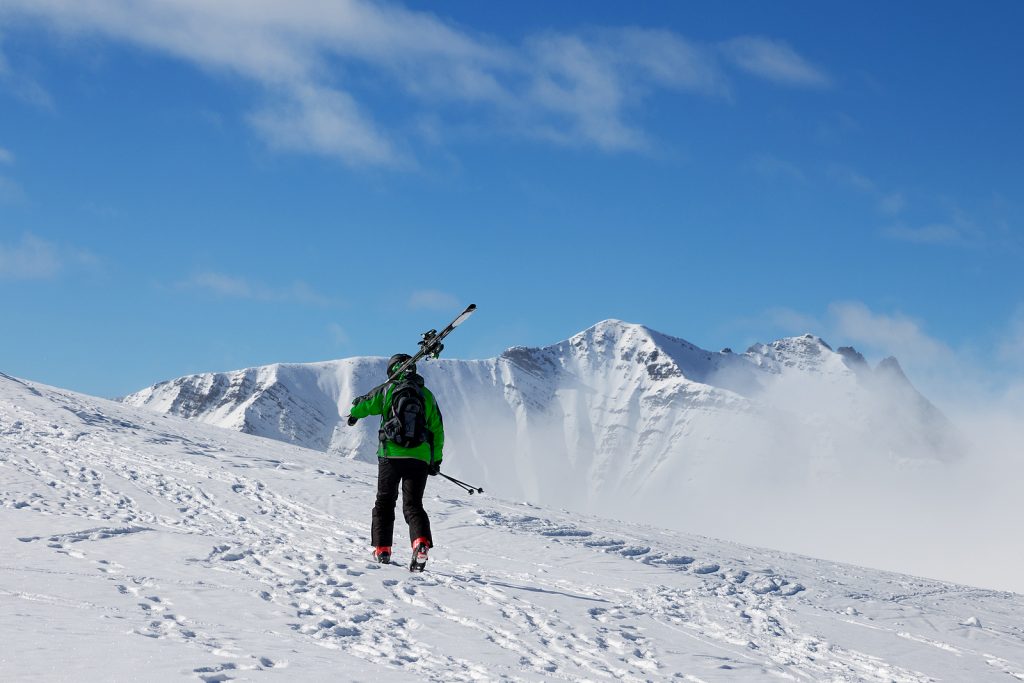
A skier heads off in look for of fresh powder at Gudauri, Ga, higher in the Caucasus Mountains
A changing demographic
When In Your Pocket printed its to start with metropolis guide, to the Lithuanian capital Vilnius in 1992, whilst intended for all it was unashamedly geared first and foremost to a backpacker generation of intrepid travellers on a shoestring finances.
As we expanded throughout emerging Europe, this strategy continued, as we remained committed to supporting travellers who required to come across the greatest worth accommodation and low cost food stuff and consume as they ended up by far their most significant demographic traveling to the location.
But by the beginning of the 2000s, nonetheless, this was commencing to adjust, and our articles adapted to cater a lot more for travellers who required to remain in the best motels, eat connoisseur meals and invest their nights in subtle clubs.
To its credit score, most of the location was by then by itself ready to accommodate these website visitors.
The growth in hotel building in the very first section of the 2000s, which noticed the biggest (and most luxurious) lodge chains open up up grand institutions across the location is proof of this.
The unexpected availability of ridiculously low-cost flights throughout Europe in the early 2000s also led to a increase in journey, this time in short city breaks, a sector that had hitherto in the location been the protect of just a couple of Central European towns, this kind of as Budapest, Krakow, and Prague.
Abruptly, people from throughout Europe could fly to Lviv, Sarajevo, Tirana, and even Tbilisi for just a couple euros. Some towns have been superior organized than other folks, and nations around the world that experienced been geared toward longer – generally seaside – vacations noticed customer numbers fall as travellers took extra, but shorter journeys.
Now, in the wake of Covid-19 they require to prepare for a new modify: a return to for a longer period vacations, dependent on ordeals and increasingly area of interest. Chook watching in Romania’s Danube Delta, heli-skiing in the Caucasus, yachting all around Croatia’s hundreds of islands.
The one-dimensions-matches-all strategy to journey is no for a longer time a winner, and international locations, areas and cities which have developed their tourism sectors on these a approach could come across on their own battling. Those people who have by no means taken vacation very seriously meanwhile will be left even further behind.
It’s time to rethink journey and tourism. Its long run will be sustainable, and personal. Financial investment in the sector – be it general public or non-public – will need to have to get this into account.
As opposed to many news and information platforms, Rising Europe is absolutely free to read, and normally will be. There is no paywall here. We are unbiased, not affiliated with nor representing any political occasion or business organisation. We want the incredibly ideal for rising Europe, practically nothing additional, nothing a lot less. Your guidance will aid us go on to spread the word about this amazing region.